

Museum pins as educational tools: proven strategies
TL;DR:
- Museum pins serve as tactile, wearable tools that reinforce exhibit themes and extend learning beyond visits.
- Designing pins with thematic accuracy, durable materials, and informative backing enhances their educational impact.
- Participatory programs like workshops and series releases increase visitor engagement and encourage repeat visits.
Most museum professionals treat pins as an afterthought, a small item near the exit that visitors grab on impulse. That assumption leaves enormous educational value on the table. Custom enamel pins, when thoughtfully designed and programmed, can reinforce exhibit themes, spark conversations, and extend learning long after visitors leave your galleries. Museum pins serve as educational tools by distilling complex themes into accessible, wearable symbols that reach far beyond the museum visit itself. This guide walks through the evidence, practical design strategies, hands-on program formats, and real case studies, so you can build a pin program that genuinely transforms how your audience learns and connects.
Table of Contents
- Why museum pins work as educational tools
- Design strategies: Making museum pins meaningful
- Hands-on pin programs: Engaging visitors more deeply
- Case studies: Museum pin programs in action
- An expert perspective: Lessons from evolving pin practices
- Start your museum’s educational pin journey
- Frequently asked questions
Key Takeaways
| Point | Details |
|---|---|
| Pins amplify visitor learning | Enamel pins support memory and learning by connecting visitors to exhibit themes in accessible, lasting ways. |
| Smart designs boost impact | Pins that tie directly to exhibits and include contextual stories enhance both engagement and educational value. |
| Interactive programs drive results | Hands-on pin creation and collection activities significantly increase visitor participation and repeat visits. |
| Every pin should serve a purpose | The most effective pin programs balance collectibility with clear educational and engagement goals. |
Why museum pins work as educational tools
Now that we recognize pins are more than simple keepsakes, let’s examine what makes them effective educational tools.
A pin is a physical object you carry with you. That matters more than it sounds. When visitors handle something tactile tied to an exhibit, their brains encode the experience differently than when they simply read a label or watch a video. Handling museum artifacts significantly improves recognition and recall compared to viewing objects behind display cases. A pin worn on a jacket or bag becomes a daily, low-effort trigger that brings the exhibit back to mind.
Beyond personal memory, pins carry powerful social energy. Every time someone notices a pin and asks about it, the original visitor becomes a storyteller. Pins spark curiosity as conversation starters, prompting owners to recount museum experiences and share learned knowledge, amplifying educational impact far outside your walls. That word-of-mouth effect is genuinely difficult to replicate with any other museum merchandise.
“Museum pins serve as educational tools by distilling complex themes into accessible, wearable symbols that reinforce learning and extend educational reach beyond the museum visit.” — Wonderful Museums
Here is a quick summary of the core reasons pins work so well in educational settings:
- Tactile reinforcement: Physical interaction encodes memories more deeply than passive observation alone.
- Wearable visibility: Pins travel into schools, offices, and homes, keeping exhibit themes alive in daily life.
- Conversation catalysts: They invite questions, giving visitors a natural opportunity to share what they learned.
- Accessible symbolism: A well-designed icon communicates a complex idea at a glance, lowering barriers for younger or less experienced visitors.
- Emotional connection: Owning a pin tied to a meaningful exhibit creates a sense of personal investment in the subject.
For Israeli museums, which often carry the weight of deep historical narratives and cultural identity, this combination of memory, advocacy, and accessibility is especially powerful. Pins can translate the complexity of archaeological finds, diaspora stories, or contemporary social themes into a format that visitors of all ages can carry forward. Explore how visitor engagement with museum branding pins can shift from passive to active when the right design strategy is in place.
Design strategies: Making museum pins meaningful
With a foundation in place, the focus shifts to practical steps, specifically how to design pins that maximize their teaching impact.
The most important design principle is thematic alignment. Every element of a pin, its shape, color palette, and iconography, should connect directly to an exhibit’s core message. A pin shaped like a Tel Dan inscription fragment or a mosaic tile from Caesarea immediately signals its educational context. Visitors do not need to read a label to understand what the pin represents.

Design pins with thematic ties to exhibits, include backing cards or online blurbs with historical context, produce via die-struck enamel for durability and appeal, and release in series to encourage repeat visits. That four-part framework is a reliable starting point for any museum education team.
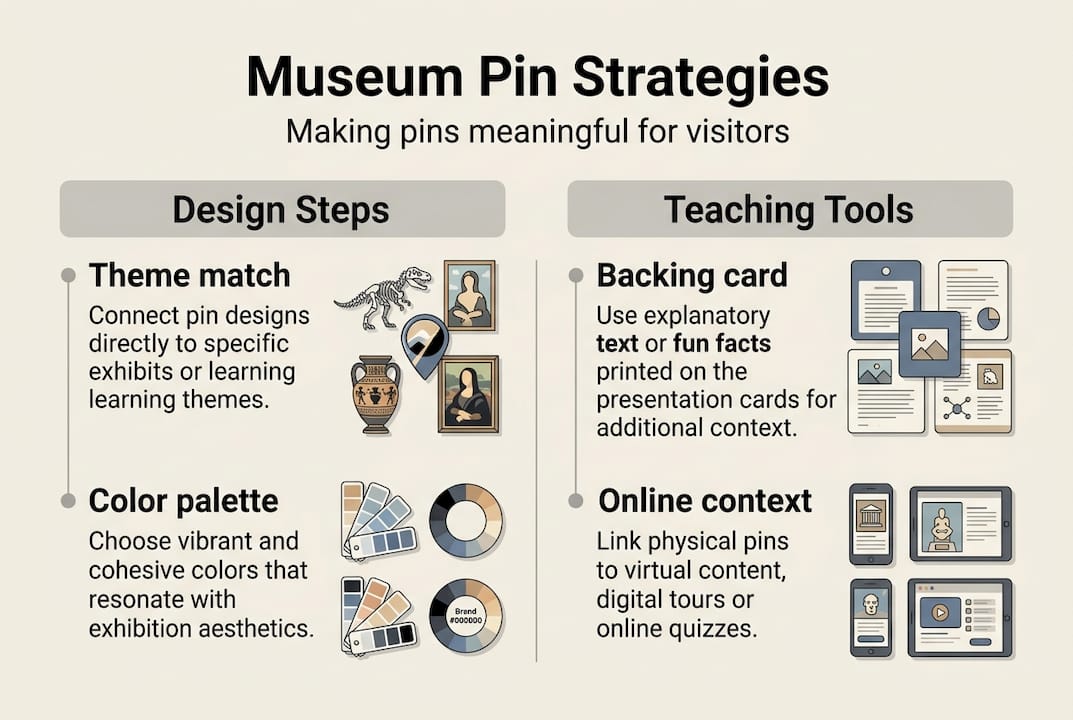
Backing cards deserve special attention. A small card attached to the pin can include a paragraph of historical context, a QR code linking to a deeper online resource, or even a short activity prompt for children. This turns the pin from a souvenir into a portable learning artifact. Understanding custom pin craftsmanship helps you make informed choices about finish and durability so the educational object lasts.
When choosing materials, the enamel versus acrylic decision matters for educational contexts:
| Feature | Hard enamel | Soft enamel | Acrylic |
|---|---|---|---|
| Durability | Very high | High | Moderate |
| Detail level | High | Very high | Very high |
| Cost per unit | Higher | Moderate | Lower |
| Best for | Permanent collections | Exhibit series | Workshops, kids’ programs |
| Educational appeal | Premium, collectible | Versatile, colorful | Customizable, lightweight |
For flagship educational series, enamel is the clear choice. For workshop activities where children create their own designs, acrylic offers flexibility and lower cost. Staying current with recent pin trends also helps you design pieces that feel contemporary and appealing to younger audiences. You can read a detailed breakdown of enamel vs acrylic pin fit to match material choices to your specific program goals.
Pro Tip: Release pins in a themed series of four to six designs rather than as standalone items. Staggered releases give visitors a reason to return, and series completion creates a satisfying sense of accomplishment that deepens engagement with your exhibit narrative.
Hands-on pin programs: Engaging visitors more deeply
Equipped with strategies for crafting meaningful pins, let’s explore participatory approaches for bringing visitors into the process.
Passive ownership of a pin is valuable, but active creation is transformative. When visitors design or assemble their own pins during a museum visit, they move from audience to participant. That shift dramatically increases retention and personal connection to the subject matter. Hands-on pin-making activities, like MOSI’s Passport Program, enhance engagement and education by allowing visitors to create custom designs tied to exhibits.
Here are four program formats that work well across different museum types and age groups:
- Pin design workshops: Visitors sketch a design inspired by a specific exhibit, and educators facilitate a discussion about the symbols they chose and why. This works especially well for history and archaeology museums.
- Passport programs: Visitors receive a booklet and collect a stamp or pin at each exhibit station. Completing the passport earns a special edition pin, motivating thorough exploration of the full museum.
- Guided treasure hunts: Clues lead visitors to specific artifacts or panels, and each stop rewards a pin or pin component. This format suits family groups and school visits.
- Community co-design: Invite local schools or community groups to submit designs for an upcoming pin series, then produce and credit their work. This builds ownership and pride in the institution.
The data below illustrates how different program formats compare on key outcomes:
| Program type | Best age group | Avg. time on task | Repeat visit impact |
|---|---|---|---|
| Design workshop | 10 and up | 45 to 60 min | Moderate |
| Passport program | All ages | Full visit | High |
| Treasure hunt | 6 to 14 | 30 to 45 min | Moderate |
| Community co-design | Teens and adults | Multi-session | Very high |
For educators planning school curricula integration, understanding the custom pin manufacturing guide helps you anticipate lead times and material options when scheduling programs. You can also explore collaborative pin design approaches that bring students and educators into the creative process together.
Pro Tip: When running pin programs for school groups, connect each activity to a specific learning objective in the national curriculum. Teachers are far more likely to book repeat visits when they can show administrators a clear educational outcome tied to the experience.
Case studies: Museum pin programs in action
To ground these strategies in reality, let’s look at museums successfully using pin programs to drive engagement and education.
Case studies show successful pin programs across multiple institution types. The Metropolitan Museum of Art’s “Ancient Wonders” series paired each pin with a short educational blurb on the backing card. Visitors who purchased the series reported returning to complete their collections, and the blurbs prompted many to seek out the specific artifacts depicted during their next visit. That feedback loop between object, pin, and gallery is exactly the kind of sustained engagement every museum aims for.
An aviation museum used pins as teaching aids specifically for children. Each pin in the series represented a different era of flight, and educators used them as physical prompts during guided tours. Children were asked to hold the relevant pin while the guide explained that period, creating a tactile anchor for the information. Post-visit surveys showed stronger recall among children who participated compared to those who took the standard tour.
A conservation-focused institution took a different angle, pairing pins with advocacy messaging. Each pin depicted an endangered species featured in their exhibit, and the backing card explained the specific threat and one action visitors could take. This approach turned a pin into a wearable commitment, connecting exhibit content to real-world behavior change.
Key takeaways for Israeli institutions:
- Tie every pin to a specific artifact or narrative thread in the exhibit, not just the museum’s general brand.
- Use backing cards as micro-lessons, keeping text to 80 words or fewer for maximum readability.
- Track repeat visits connected to series releases to measure actual educational impact.
- Involve educators early in the design process so pins align with school curriculum goals.
Explore how collaborative museum pin programs can amplify both educational reach and institutional visibility when designed with clear intent.
An expert perspective: Lessons from evolving pin practices
After reviewing current best practices, it is vital to reflect on what truly drives meaningful results, and where many museums go wrong.
The most common mistake we see is treating pins as a revenue stream first and an educational tool second. When the design brief starts with “what will sell” rather than “what will teach,” the educational value collapses. You end up with attractive merchandise that visitors forget within a week.
History actually warns us here. Pilgrim badges show a long-standing tradition of wearable symbols carrying meaning, but they declined when the cultural and spiritual context that gave them power faded. The object alone was never enough. The same risk applies today. A beautifully crafted enamel pin without a clear educational anchor is just decoration.
At PinPerfect, we believe the strongest programs start with a learning objective written before any design work begins. Ask yourself: what should a visitor know, feel, or do differently after engaging with this pin? If you cannot answer that in one sentence, the design process is not ready to start. Test your programs, gather visitor feedback, and refine. The museums seeing the greatest impact treat pins as living educational tools, not static products.
Start your museum’s educational pin journey
Ready to build your own museum pin program? Here’s how to get started.
The strategies in this guide are only as powerful as the partner you choose to bring them to life. At PinPerfect, we work directly with museum professionals and educators to create pins that carry real educational weight, from initial concept and thematic design through to production and delivery across Israel and beyond.
Whether you are launching a passport program, designing a series tied to a landmark exhibit, or exploring community co-design with local schools, our team brings both craft and cultural awareness to every project. Orders over 300 NIS ship free within Israel, and our in-house design team is ready to collaborate from your first sketch to the final pin. Visit custom museum pin solutions to explore options and start a conversation today.
Frequently asked questions
How can museum pins enhance learning for children and families?
Pins create a tactile, visual connection to exhibit themes that makes information stick for younger visitors. Pins spark curiosity as conversation starters, encouraging children to share and revisit what they learned long after the visit ends.
What are the best practices for designing educational museum pins?
Align pin imagery directly with exhibit content, use durable enamel for longevity, and attach backing cards with concise historical context. Design pins with thematic ties to exhibits and include informative blurbs to transform a pin from souvenir into a portable learning artifact.
How can museums use pins to encourage repeat visits?
Releasing pins in a themed series, or connecting them to a passport completion program, gives visitors a compelling reason to return. Staggered releases drove repeat visits and sustained engagement across multiple institutions that tested this format.
What evidence shows that pins help visitor recall?
Tactile interaction with objects tied to exhibit content strengthens memory encoding significantly. Handling museum artifacts improves recognition and recall by over 75% compared to passive viewing, making physical pins a meaningful memory aid for visitors of all ages.
Recommended
- Museum branding pins boost visitor engagement 50% – PinPerfect
- 10 unique educational enamel pin ideas for teachers – PinPerfect
- Role of Pins in Events: 50% Boost in Engagement & Recall – PinPerfect
- Custom pins in fundraising: boost engagement and donations – PinPerfect
- Rôle des illustrations sur cartes : impact sur l’attrait et la valeur - JM Cards