

How Reviews Shape Custom Merchandise Choices and Trust
TL;DR:
- Online reviews are the most influential factor in custom merchandise purchases, surpassing visuals.
- Responding promptly to reviews, especially negative ones, significantly boosts sales and trust.
- Authentic customer feedback and transparency are key to converting buyers in personalized product markets.
Nearly every shopper reads reviews before placing a custom merchandise order, yet most businesses still pour their energy into product photography and price positioning. 96% of consumers name reviews as the single most influential factor in their purchase decisions, outranking visuals, brand reputation, and even personal recommendations. For businesses, cultural organizations, and event planners ordering custom pins, magnets, or keychains, that statistic carries real weight. This article breaks down why reviews hold such outsized power in the custom merchandise space, how buyers actually use them, and what your organization can do right now to turn review strategy into a genuine competitive advantage.
Table of Contents
- Why reviews matter more than ever in custom merchandise
- How reviews directly drive buying behavior for personalized merchandise
- What customers and buyers really check: review details that matter
- Best practices for businesses: Leveraging and responding to reviews
- A fresh take: Why review strategy trumps product visuals in today’s custom merch market
- Ready to upgrade your custom merchandise strategy?
- Frequently asked questions
Key Takeaways
| Point | Details |
|---|---|
| Reviews are critical | Nearly all buyers require trusted reviews before purchasing custom merchandise. |
| Negative feedback is double-edged | Negative reviews hurt sales, but responding to them can boost conversions substantially. |
| Quality details matter | Buyers closely check reviews for durability, color accuracy, and seller reliability. |
| Transparency increases trust | Displaying all reviews—good and bad—signals authenticity and encourages purchases. |
Why reviews matter more than ever in custom merchandise
Custom merchandise is deeply personal. Whether you are ordering branded enamel pins for a corporate event or commemorative magnets for a cultural institution, buyers are investing in something that represents their identity, their values, or their organization’s story. That emotional stake raises the bar for trust considerably. People want proof from others who have been there before them.
91% of customers rely on online reviews when making purchasing decisions, and 85% of businesses recognize reviews as critical to their credibility. These numbers are not surprising when you consider what buyers are actually looking for. When scanning reviews for custom merchandise, shoppers focus on:
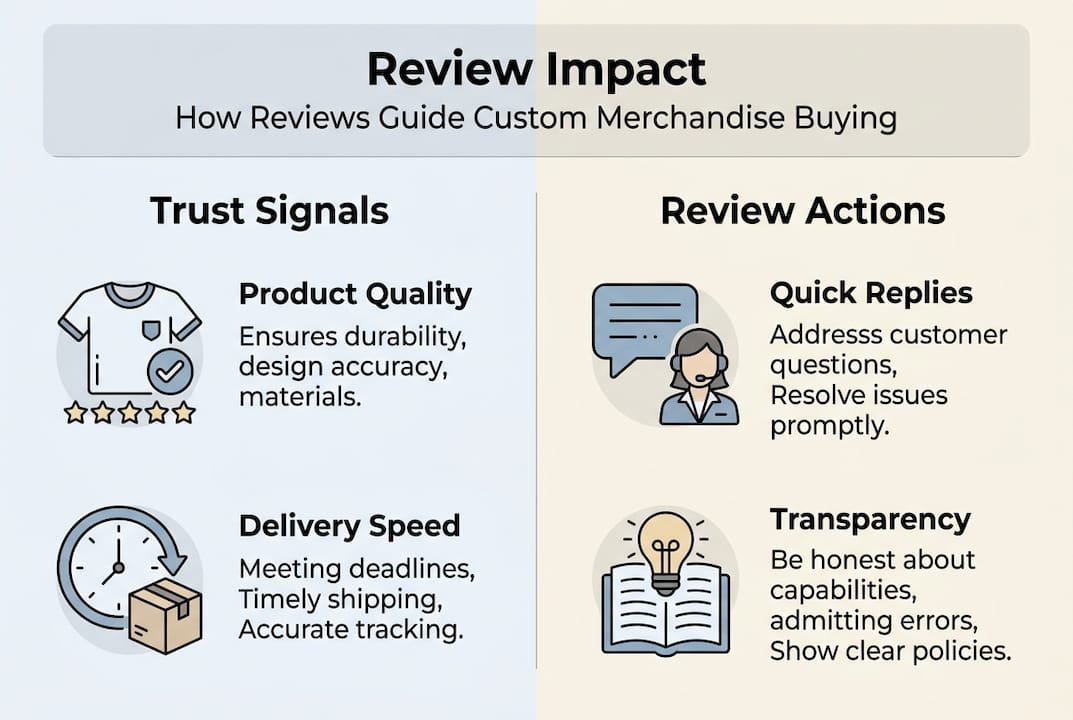
- Product quality and durability: Does the enamel hold up after repeated use? Are the edges clean?
- Color accuracy: Does the finished product match the approved design file?
- Service reliability: Was the team responsive? Did they catch errors before production?
- Delivery consistency: Did orders arrive on time and in good condition?
Understanding custom designs impact goes beyond aesthetics. Buyers want to know that the supplier can translate a vision into a physical product without surprises. Reviews are the closest thing to a guarantee they can get.
85% of shoppers are less likely to buy from a vendor with zero reviews, and 96% actively seek out negative reviews first to identify potential problems before committing.
User reviews carry the highest weight in e-commerce purchasing decisions, particularly in live or real-time marketing contexts. For event planners who understand the lasting impact of souvenirs on audience engagement, this insight is especially relevant. Reviews are not just social proof. They are the primary trust mechanism in the custom merchandise buying journey.
How reviews directly drive buying behavior for personalized merchandise
Custom merchandise often sits at a higher price point than off-the-shelf products. A bulk order of custom enamel pins or branded keychains represents a meaningful budget commitment, which means buyers approach the decision carefully. Here is how the review-driven buying process typically unfolds:
- Discovery: A buyer finds your product page or storefront and immediately looks for a star rating.
- Negative review scan: Before reading positives, most shoppers scroll to the lowest-rated reviews to identify deal-breakers.
- Response check: Buyers then look at whether the vendor responded to those negative reviews and how.
- Volume assessment: A product with 200 reviews at 4.2 stars often outperforms one with 10 reviews at 5 stars.
- Photo verification: Buyers look for customer-submitted photos to confirm that the product looks as advertised in real-world conditions.
| Review type | Effect on buyer trust | Effect on conversion rate |
|---|---|---|
| Positive reviews | Strong trust boost (β=0.52) | Significant increase |
| Negative reviews (unanswered) | Trust erosion (β=0.48) | Reduces conversions by up to 61% |
| Negative reviews (answered) | Trust recovery | Can increase conversions by up to 144% |
| No reviews at all | High uncertainty | 85% less likely to purchase |
Positive reviews build trust measurably, while negative reviews without a response actively suppress purchase intent. The good news is that responding to criticism transforms the dynamic entirely. For organizations exploring selling custom magnets or other branded accessories, understanding this mechanism is a practical advantage.
Pro Tip: Always respond to every negative or neutral review within 48 hours. A thoughtful, solution-focused reply signals to future buyers that your organization takes quality seriously, which can lift conversion rates dramatically. The response is often more persuasive than the original complaint.
The personalized merchandise benefits extend far beyond the product itself. How you manage your review presence becomes part of the brand experience.
What customers and buyers really check: review details that matter
Not all review content carries equal weight. Savvy buyers in the custom merchandise space have learned to read between the lines, and they are scanning for very specific signals before placing an order.
| Review topic | Why buyers check it | Red flag indicators |
|---|---|---|
| Product durability | Custom items must survive repeated use | Mentions of peeling, fading, or breaking |
| Color fidelity | Design accuracy is non-negotiable | Reports of color mismatch or dull finishes |
| Delivery time | Events have hard deadlines | Consistent late delivery complaints |
| Customer service | Problems happen; responsiveness matters | Ignored complaints or slow replies |
| Packaging quality | Merchandise often given as gifts | Damaged goods on arrival |
Common review red flags that buyers treat as automatic disqualifiers include:
- Repeated mentions of color mismatch between approved proofs and delivered products
- Multiple complaints about peeling or flaking on enamel or printed surfaces
- No vendor response to any critical feedback
- Vague, generic reviews that lack specific product details (these read as inauthentic)
Must-have signals that build confidence:
- Customer-submitted photos showing the product in real use
- Specific praise for quality, accuracy, or service by name
- Vendor replies that show genuine follow-through
Quality issues like peeling ink or color mismatch amplify negative review impact far beyond what a standard product complaint would generate. The reason is simple: customization raises expectations. When a buyer has invested in a unique design, any deviation from that vision feels like a personal failure, not just a product defect.

Pro Tip: Before placing a large order, always request a physical sample or a small pilot batch. This step protects your investment and gives you firsthand material to share with your own stakeholders as proof of quality.
96% of shoppers check negative reviews first, which means your weakest reviews are often the first impression a potential buyer forms. Understanding bespoke brand impact means recognizing that quality control and review management are inseparable. Any guide to promotional merchandise worth reading will tell you the same thing.
Best practices for businesses: Leveraging and responding to reviews
Knowing what buyers look for is only half the equation. The other half is actively building and managing a review presence that works in your favor. Here is a practical, step-by-step approach:
- Claim your review profiles on every platform where your products appear. Unclaimed profiles signal neglect.
- Request feedback systematically. After every fulfilled order, send a short, friendly follow-up asking for an honest review. Timing matters: reach out within 5 to 7 days of delivery.
- Feature authentic customer photos. Encourage buyers to share images of your products in use and display them prominently alongside written reviews.
- Respond to every review, positive or negative. A warm thank-you to a positive review reinforces the relationship. A professional, solution-oriented reply to a negative one demonstrates accountability.
- Avoid filtering out negatives. Buyers can spot curated review sections immediately, and the absence of criticism reads as suspicious rather than reassuring.
For organizations ordering custom pins at scale or branding with keychains, the review cycle is an ongoing process, not a one-time setup.
Responding to reviews increases conversions by 144%. That single action, replying to feedback, is one of the highest-return activities available to any custom merchandise business.
The data is clear. Responding to reviews is not just good customer service. It is a measurable growth strategy. Businesses that treat review management as a core function, rather than an afterthought, consistently outperform those that do not.
A fresh take: Why review strategy trumps product visuals in today’s custom merch market
Here is something most brands get wrong: they spend thousands on professional product photography and almost nothing on review strategy. The assumption is that stunning visuals close the sale. In the custom merchandise world, that assumption is costly.
At PinPerfect, we have seen it repeatedly. A beautifully photographed product page with sparse reviews loses to a simpler page with 80 authentic, detailed reviews every single time. Buyers in this space are not just buying a product. They are buying a promise, and no photo can fulfill a promise the way a real customer’s words can.
Cultural organizations and event planners face especially high stakes. A missed deadline or a color mismatch on a commemorative pin is not just a product issue. It is a reputational one. That is why the most effective operators we work with invest in collecting custom pins feedback as seriously as they invest in design quality.
Openness to negative reviews is not a weakness. It is a signal of confidence and service orientation. The brands that hide criticism are the ones buyers trust least.
Ready to upgrade your custom merchandise strategy?
If you are ready to act on what you have learned, getting started is easier than you think. At PinPerfect, we believe that trust is built one authentic experience at a time, and our review-rich platform reflects exactly that.
Browse our most loved designs to see what real customers are celebrating, from cultural keepsakes to corporate branding collections. When you are ready to create something uniquely yours, our team is here to collaborate. Customize your merchandise with confidence, backed by a process that prioritizes quality, accuracy, and your satisfaction at every step. Let your next order speak for itself.
Frequently asked questions
Which review factors matter most to custom merchandise buyers?
Buyers pay closest attention to product quality, color accuracy, customer service responsiveness, and delivery speed. In custom apparel and accessories, product flaws amplify negative review impact significantly, making these details especially critical.
Do negative reviews always hurt custom merchandise sales?
Not necessarily. Negative reviews reduce conversions by 61% when left unanswered, but responding promptly and professionally can increase conversions by up to 144%, turning a liability into a trust signal.
Should businesses show every review, even critical ones?
Absolutely. Transparency with reviews increases buyer trust and conversion rates. Hiding negative feedback signals to shoppers that something is being concealed, which erodes confidence faster than any bad review would.
How do reviews differ in impact for custom versus standard merchandise?
For custom merchandise, reviews carry even more weight because buyers cannot see or touch the item before ordering and personalization typically makes returns difficult. Reviews can drive up to 380% more conversions for custom or high-ticket items compared to standard product categories.