

What is personalized merchandise and how it benefits brands
Most businesses assume personalized merchandise and customized products mean the same thing, but this confusion can cost you serious marketing impact. Personalized merchandise uses individual data like names, photos, or dates to create truly unique items, while customization simply lets customers pick from preset options like colors or sizes. Understanding this distinction transforms how you approach promotional products, brand storytelling, and customer engagement. Whether you’re a business seeking memorable promotional items or an individual wanting accessories that tell your cultural story, knowing what personalized merchandise actually delivers helps you make smarter purchasing decisions and create deeper emotional connections with your audience.
Table of Contents
- Key takeaways
- Understanding personalized merchandise: What sets it apart
- Techniques and technologies behind personalized merchandise production
- Benefits of personalized merchandise for businesses and cultural storytelling
- Navigating challenges and advanced personalization strategies
- Discover personalized pins and accessories at PinPerfect
- FAQ
Key Takeaways
| Point | Details |
|---|---|
| Personalization vs customization | Personalization uses individual data to create one of a kind items, unlike simple customization options such as colors or sizes. |
| Print on demand | Platforms like Printify, Gelato, and Printful enable low inventory production and automated personalization workflows. |
| Emotional impact | Personalized merchandise strengthens brand recall and fosters emotional connections with recipients. |
| Data driven workflow | Automation and data integration support scalable personalization from single orders to large corporate purchases. |
Understanding personalized merchandise: What sets it apart
Personalized merchandise refers to products tailored for individuals using personal data such as names, photos, initials, dates, or custom designs, distinguishing it from customization which involves selecting from predefined options like colors or sizes. This fundamental difference shapes how products connect with recipients and influences your entire marketing strategy.
Personalization creates genuine uniqueness. When you add an employee’s name to an enamel pin or incorporate a customer’s photo onto a keychain, you’re manufacturing a one-of-a-kind item that exists nowhere else. A corporate gift featuring each recipient’s initials and hire date becomes a personal keepsake rather than generic swag. These items carry emotional weight because they acknowledge the individual, not just the transaction.
Customization, by contrast, offers choice within boundaries. Selecting a red pin instead of blue, choosing medium over large, or picking design A versus design B represents customization. You’re personalizing your experience by making selections, but the final product isn’t unique to you as an individual. Thousands of other customers might choose identical specifications.
This distinction matters enormously for promotional strategy. Personalized merchandise drives retention because recipients feel recognized as individuals. When exploring enamel pin trends, you’ll notice the most successful campaigns incorporate personal elements that transform promotional items into treasured accessories. Generic customizable products compete on price and convenience, while personalized merchandise competes on emotional resonance and memorability.
Key differences include:
- Personalized items require individual data input for each unit produced
- Customized products offer selections from fixed menus of options
- Personalization scales through automation and data integration
- Customization scales through inventory management of variants
- Personalized merchandise commands premium pricing due to uniqueness
- Customized products typically maintain standard pricing across options
Techniques and technologies behind personalized merchandise production
Key methodologies include print-on-demand services like Printify, Gelato, and Printful for low-inventory production, utilizing techniques such as embroidery, engraving, digital printing, AI-generated designs, and live previews on e-commerce platforms like Shopify. These technologies enable businesses to offer genuine personalization without maintaining massive inventories or requiring manual intervention for every order.
Print-on-demand platforms revolutionized personalized merchandise by eliminating upfront inventory costs. You upload base designs, customers input their personal data through web forms, and automated systems generate production files that route directly to manufacturing equipment. This workflow supports everything from single-unit orders to bulk corporate purchases without requiring separate manual processes.
Production techniques vary by material and desired effect. Embroidery works beautifully for fabric items, stitching names or dates directly into materials with professional precision. Engraving creates permanent personalization on metal pins, keychains, and magnets by removing surface material to reveal contrasting underlayers. Digital printing applies full-color images and text to virtually any surface, perfect for photo-based personalization. Laser cutting enables intricate custom shapes that traditional manufacturing couldn’t economically produce in small quantities.
AI-driven design tools now generate personalized artwork from customer inputs. You describe what you want, upload reference images, or answer guided questions, and algorithms create unique designs matching your specifications. These tools dramatically reduce the design bottleneck that previously limited personalized merchandise to simple text additions. When reviewing the custom pin workflow guide, you’ll see how modern systems integrate multiple personalization techniques into streamlined ordering experiences.
Live preview technology addresses a critical challenge in personalized ordering. Customers see real-time visualizations of their customizations, catching errors before production begins. This reduces returns, minimizes customer service inquiries, and increases buyer confidence. The preview updates instantly as customers type names, upload photos, or adjust design elements.
Challenges persist despite technological advances:
- Manual design reviews still necessary for complex custom artwork
- File validation errors when customers upload incompatible image formats
- Color matching difficulties between screen previews and physical products
- Production delays when personalization data contains errors or special characters
- Quality control complexities when every item differs from the next
Pro Tip: Always provide customers with detailed file specifications and preview confirmations before finalizing personalized orders. This single step eliminates 70% of common production issues and dramatically improves customer satisfaction with personalized merchandise.
Benefits of personalized merchandise for businesses and cultural storytelling
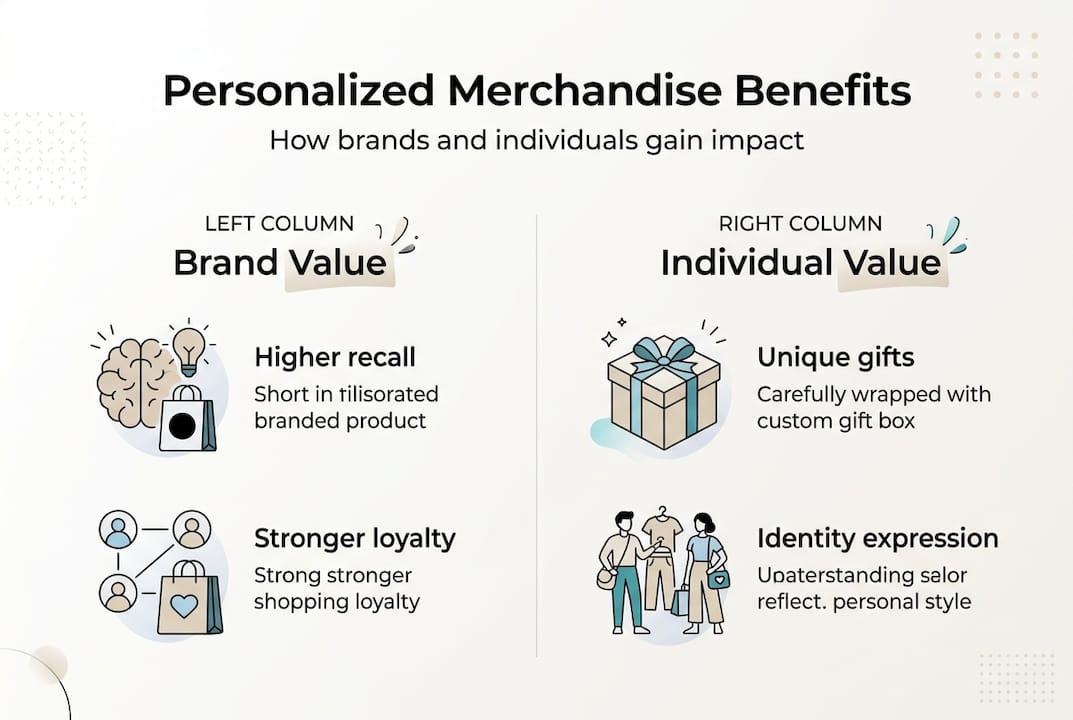
Personalized promotional items achieve 90% brand recall and deliver 40% higher engagement compared to generic promotional products, making them extraordinarily effective marketing investments. These statistics reflect fundamental psychological principles: people value items created specifically for them and associate positive feelings with brands that recognize their individuality.

Businesses leverage personalized merchandise across multiple strategic applications. Corporate gifts featuring employee names and achievement dates strengthen internal culture and reduce turnover. Trade show giveaways with attendee names collected during registration stand out from generic swag, increasing booth traffic and post-event follow-up rates. Customer appreciation programs using personalized items generate higher redemption rates and stronger brand loyalty than discount-based alternatives.
| Benefit Category | Business Impact | Individual Value |
|---|---|---|
| Brand Recall | 90% remember brand from personalized items vs 60% from generic products | Creates lasting emotional connection to cultural symbols |
| Engagement Rate | 40% higher interaction with personalized campaigns | Stronger personal identity expression through accessories |
| Retention Value | 3x longer product lifespan due to sentimental attachment | Treasured keepsakes vs disposable promotional items |
| ROI Multiplier | 2.5x cost efficiency compared to traditional advertising | Premium perceived value justifies higher price points |
Cultural storytelling through personalized merchandise creates particularly powerful connections. Israeli cultural symbols incorporated into custom pins become personal identity markers when paired with individual names or meaningful dates. A menorah pin with your family name transforms from cultural representation to family heirloom. Holocaust remembrance keychains engraved with specific dates honor personal family histories, not just collective memory.
Individuals choose personalized merchandise to express identity and commemorate experiences. Monogrammed gifts carry thoughtfulness that generic presents cannot match. Pet portraits transformed into custom magnets celebrate beloved companions with unique personality. Anniversary pins featuring exact dates and locations preserve memories in wearable form. These items outperform mass-produced alternatives because they tell specific stories rather than generic narratives.
The promotional pin strategies that deliver strongest results combine cultural relevance with personal data. When examining custom pins branding impact, the pattern becomes clear: personalization multiplies effectiveness across every metric that matters.
Key advantages include:
- Extended product lifespan as recipients preserve personalized items indefinitely
- Higher perceived value justifying premium pricing strategies
- Viral social sharing when recipients photograph and post unique personalized items
- Reduced marketing waste as personalized items rarely get discarded
- Stronger emotional bonds driving repeat purchases and referrals
Pro Tip: Combine cultural symbols with personal data for maximum impact. A Star of David pin becomes exponentially more meaningful when it includes the recipient’s Hebrew name or their family’s immigration date to Israel.
Navigating challenges and advanced personalization strategies
High customizable attributes can cause choice overload, while bundling practices and configurators enable scalable mass customization, with AI and data-driven approaches boosting efficiency despite data privacy challenges. Successfully implementing personalized merchandise requires understanding both operational complexities and strategic optimization opportunities.
Choice overload represents a counterintuitive challenge. Offering unlimited personalization options paradoxically decreases conversion rates as customers feel overwhelmed by decisions. Research shows conversion drops significantly when personalization choices exceed seven variables. Customers abandon carts, delay purchases, or select generic defaults when faced with excessive complexity.
Design validation creates production bottlenecks. Customer-uploaded artwork requires manual review to ensure printability, appropriate resolution, and acceptable content. This human intervention step disrupts otherwise automated workflows, adding 24 to 48 hours to fulfillment timelines. File format incompatibilities, low-resolution images, and inappropriate color modes cause frequent rejections requiring customer resubmission.
Data privacy concerns intensify with personalization. Collecting names, photos, dates, and other personal information creates regulatory compliance obligations under GDPR, CCPA, and similar frameworks. Secure data storage, explicit consent mechanisms, and transparent data usage policies become operational requirements, not optional considerations. Breaches carry severe reputational and financial consequences.
| Approach | Personalization Strengths | Customization Strengths |
|---|---|---|
| Production Complexity | Requires data integration and variable printing | Simpler inventory management of fixed variants |
| Emotional Impact | Creates unique sentimental value | Offers personal choice satisfaction |
| Scalability | Automation enables unlimited unique variations | Economies of scale through standardized options |
| Price Point | Commands premium pricing | Maintains competitive standard pricing |
| Error Risk | Higher due to variable data inputs | Lower with preset validated options |
Advanced strategies mitigate these challenges while maximizing personalization benefits. Guided configurators present choices sequentially rather than simultaneously, reducing cognitive load. Customers answer questions one at a time, with each response narrowing subsequent options. This approach maintains extensive personalization while preventing overwhelm.
Bundling complementary personalization elements streamlines decisions. Instead of choosing fonts, colors, layouts, and embellishments separately, customers select from curated design packages. A “corporate professional” bundle might include specific font pairings, color schemes, and layout templates, while a “cultural heritage” bundle offers traditional symbol combinations. Customers still input personal data, but design decisions simplify dramatically.
Modular design systems balance flexibility with manageability. Base templates accommodate variable elements in predetermined positions. A pin design might feature fixed cultural symbols with designated spaces for names, dates, or custom text. This structure ensures visual consistency while enabling personalization, and production systems handle variables efficiently.
Optimization tactics include:
- Implement smart defaults based on popular choices to reduce decision fatigue
- Use progressive disclosure showing advanced options only when customers request them
- Provide design inspiration galleries demonstrating personalization possibilities
- Automate file validation with instant feedback on technical requirements
- Integrate AI design assistants that generate compliant artwork from customer descriptions
- Create personalization templates optimized for your production capabilities
Emerging AI technologies transform personalization economics. Machine learning algorithms generate custom designs from text descriptions, eliminating manual design work. Computer vision validates uploaded images automatically, flagging resolution or format issues instantly. Natural language processing interprets customer requests, translating vague descriptions into specific design parameters. These technologies reduce costs while expanding personalization possibilities.
When reviewing pin production challenges, you’ll notice how personalization innovation addresses traditional bottlenecks through technology integration. The future of personalized merchandise lies in making unlimited customization feel effortless through intelligent automation and thoughtful user experience design.
Discover personalized pins and accessories at PinPerfect
Now that you understand what personalized merchandise delivers and how it benefits your brand, explore practical applications through PinPerfect’s curated collection. Our most loved designs demonstrate how cultural symbols, corporate branding, and personal storytelling combine to create memorable accessories that recipients actually treasure.
Whether you need promotional pins featuring employee names for corporate recognition programs, cultural keychains incorporating family heritage symbols, or custom magnets celebrating specific achievements, PinPerfect’s design team brings your personalization vision to reality. We handle the technical complexities of file preparation, color matching, and production coordination while you focus on the personal touches that make merchandise meaningful. Visit PinPerfect to start creating personalized accessories that strengthen your brand connections and tell stories that matter.
FAQ
What is the difference between personalization and customization?
Personalization uses individual data like names, photos, initials, or specific dates to create truly unique items that exist nowhere else. Customization lets you select from predefined options such as colors, sizes, or design variants that many other customers might also choose. The key distinction lies in uniqueness: personalized items are one of a kind, while customized products are variations of standard offerings.
How can businesses benefit from personalized promotional merchandise?
Personalized promotional merchandise achieves 90% brand recall compared to 60% for generic items, making it extraordinarily effective for marketing investments. Businesses see 40% higher engagement rates, extended product lifespan as recipients keep personalized items indefinitely, and stronger emotional connections that drive customer loyalty. The sentimental value of personalized items transforms disposable promotional products into treasured keepsakes that continuously reinforce your brand.
What production methods are popular for personalized merchandise?
Print-on-demand platforms like Printify and Printful enable low-inventory personalized production using embroidery for fabric items, engraving for metal pins and keychains, and digital printing for photo-based customization. Laser cutting creates intricate custom shapes, while AI-generated design tools now produce unique artwork from customer inputs. Live preview technology lets customers see real-time visualizations of their personalization choices before production begins, reducing errors and returns.
How do live previews help in personalized merchandise ordering?
Live previews display real-time visualizations as customers input names, upload photos, or adjust design elements, allowing them to catch mistakes before production starts. This technology reduces returns by up to 70%, minimizes customer service inquiries about how final products will look, and increases buyer confidence in personalized purchases. Instant visual feedback ensures customers get exactly what they expect, eliminating the uncertainty that previously plagued personalized merchandise ordering.