

How designers drive custom product success for brands
TL;DR:
- Designers now manage brand consistency, manufacturability, and user experience in custom merchandise.
- Co-creation and proactive governance ensure practical, high-quality, and meaningful branded products.
- The greatest value lies in strategic decisions and uncertainty management, not just visual design.
Most businesses assume that hiring a designer means getting someone to make their logo look good on a pin or keychain. That assumption costs them time, money, and missed opportunities. Today’s custom product designers do far more than choose colors and arrange visual elements. They orchestrate the entire process of translating your brand story into a physical object that resonates, holds up to scrutiny, and can actually be manufactured at scale. Understanding what designers truly do changes how you invest in branded merchandise and shapes the quality of what you ultimately put in your customers’ hands.
Table of Contents
- Why designers are at the heart of custom merchandise
- Co-creation and the customer-designer partnership
- Design governance: Finding the right balance between creativity and constraints
- Prototyping: How designers ensure ideas work in the real world
- What most people miss: Designers as uncertainty managers and innovation drivers
- A designer’s perspective: Why the real value isn’t what you think
- Bring your vision to life with expert custom design support
- Frequently asked questions
Key Takeaways
| Point | Details |
|---|---|
| Designers enable co-creation | Designers partner with clients to shape unique, brand-aligned products by balancing creativity and feasibility. |
| Practicality meets creativity | Effective designers use smart constraints and configuration tools to bring bold ideas to life without production headaches. |
| Prototyping ensures success | Early prototyping catches issues and prevents costly mistakes before large-scale custom merchandise production. |
| Designers guide and reassure | Expert design guidance helps businesses navigate uncertainty and turn branding visions into impactful realities. |
| Strategic value goes beyond aesthetics | Designers drive innovation and confidence, delivering much more than just visual appeal for your organization. |
Why designers are at the heart of custom merchandise
Building from the common misconception that design is mostly about style, let’s look at how designers have become much more than stylists, especially when it comes to custom merchandise projects.
When organizations plan branded accessories like enamel pins, magnets, or keychains, they often focus on the finished image: a glossy pin bearing their logo, a sleek magnet displaying a cultural symbol, a keychain that tells their story. What they rarely see is the designer working behind the scenes to make that vision manufacturable, brand-consistent, and meaningful to the audience who will receive it.
Research confirms this expanded responsibility. In mass customization and configurable product development, designers shift from artifact generation to facilitating co-creation, balancing company identity with guidance and reassurance during the customer’s configuration process. This is a fundamental shift in what “designer” means for any brand ordering custom merchandise.
In practice, this means the designer is managing three things simultaneously:
- Brand alignment: Making sure every visual and structural decision reflects your organization’s values and identity
- Manufacturability: Ensuring creative choices can actually be produced within your budget and timeline
- User experience: Thinking about how the recipient will feel when they hold, wear, or give the item
Understanding why custom designs matter for brand impact becomes clearer when you realize designers are not decorating products. They are engineering emotional connections.
“Great custom merchandise design is not about making something pretty. It is about making something that works for your brand, your audience, and your production reality at the same time.”
This orchestration role is what separates organizations that produce forgettable branded swag from those that create pieces people actually keep and share.
Co-creation and the customer-designer partnership
Now that it’s clear why designers are central to custom merchandise, let’s unpack how co-creation between businesses and designers works in practice, fostering collaboration and impactful outcomes.
Co-creation is the process where clients and designers work together actively rather than handing off a brief and waiting for a result. For businesses ordering custom branded accessories, this collaborative model produces merchandise that feels genuinely owned by the organization, not just printed on demand.
The role of designers and product developers changes toward more openness to the voice of the customer, balancing brand identity with guidance and reassurance during co-creation. This means your designer should be asking you questions, not just presenting options. The best partnerships involve real dialogue.
Here is how a co-creation process typically unfolds for custom merchandise:
- Discovery conversation: The designer interviews key stakeholders to understand the brand story, the event context, the audience, and any cultural or organizational symbols that matter.
- Concept development: Initial directions are sketched, often including multiple routes that reflect different aspects of the brand identity.
- Client feedback round: You respond to concepts honestly, explaining what resonates and what misses the mark. This feedback is the engine of co-creation.
- Refinement and mockups: The designer narrows directions based on your input, producing detailed mockups that show scale, color accuracy, and material feel.
- Final sign-off: Both parties agree on a design that feels true to the brand and is ready for production.
When choosing bespoke merchandise over off-the-shelf options, this collaborative process is exactly what you are paying for. The result is a product that carries genuine organizational meaning rather than a generic look.
Pro Tip: Before your first designer meeting, write down three words that describe how you want recipients to feel when they receive your branded merchandise. Sharing these emotional targets early shapes the entire co-creation conversation.
Design governance: Finding the right balance between creativity and constraints
Once a co-creative mindset is established, the designer’s governance role comes into play, guiding creativity within practical frameworks that ensure every idea can become a successful product.
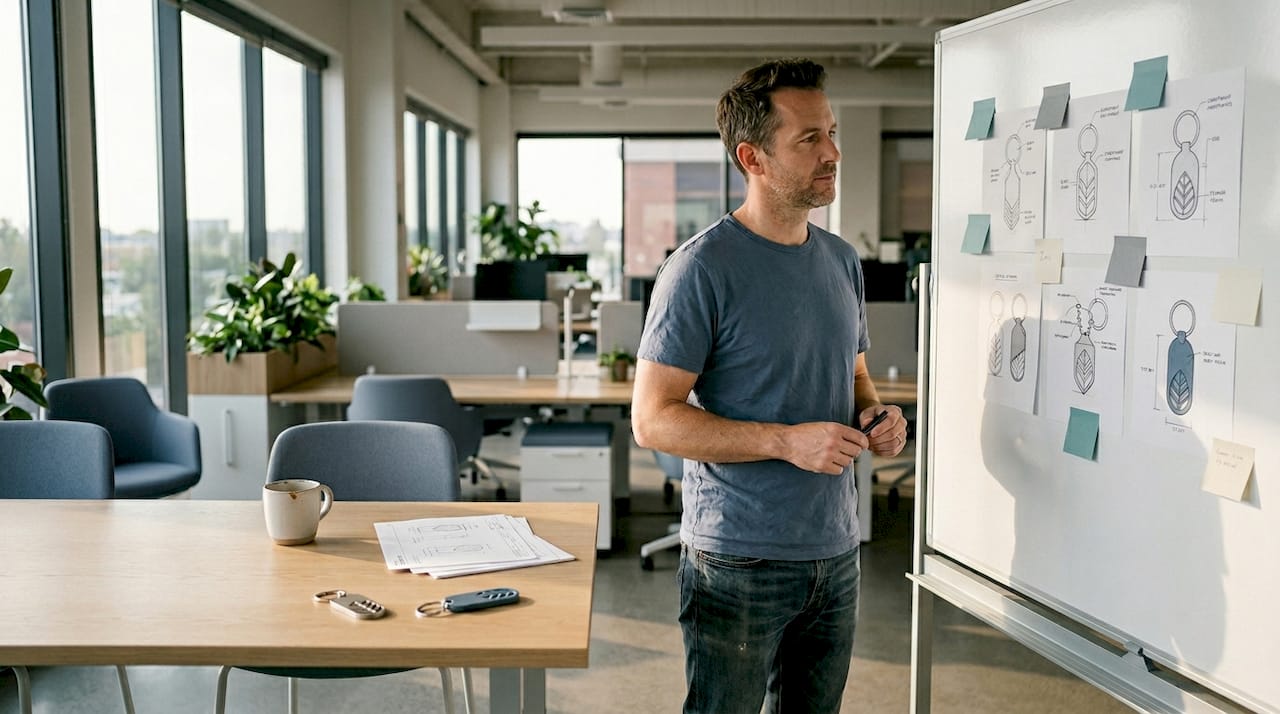
Many organizations discover, sometimes painfully, that not every design idea survives contact with manufacturing reality. An intricate hand-drawn illustration may look stunning on screen but become muddy when reduced to a 30mm enamel pin. A color palette with fifteen shades may be impossible to reproduce accurately in hard enamel within a standard budget. This is where design governance becomes essential.
Designers in customization programs are responsible for constraining the solution space so customer choices remain manufacturable, and cost, delivery, and quality tradeoffs are managed via modularity and configuration tooling. In plain terms, a skilled designer defines what is possible before you fall in love with what isn’t.
Here is a quick comparison of what governed versus ungoverned custom merchandise design looks like in practice:
| Factor | Governed design process | Ungoverned design process |
|---|---|---|
| Color choices | Limited to manufacturable options from the start | Unlimited choices that may require expensive revisions |
| Detail level | Adjusted for product size and material | Approved at screen resolution, rejected at production |
| Timeline | Predictable with fewer revision cycles | Delayed by unexpected feasibility issues |
| Budget | Stays within scope | Escalates due to rework and material changes |
| Brand consistency | Built in through defined parameters | At risk when constraints are discovered late |
The tools that support design governance include online configurators (interactive tools that show you only the choices that work for your product type), modular design systems, and material libraries that translate creative choices into real outputs.
Following a structured accessory workflow guide helps organizations understand these governance stages before they begin, saving them from costly late-stage surprises. The broader benefits of personalized merchandise are fully realized only when governance ensures that creative ambitions align with production realities.
Key governance benefits for your organization:
- Fewer revision cycles and faster time to production
- Clearer expectations on both sides of the project
- Stronger brand alignment because rules are set early
- Better cost control without sacrificing quality
Pro Tip: Ask your designer to show you the constraints before you see the creative options. Understanding what is possible upfront transforms the co-creation conversation and keeps your project on track.
Prototyping: How designers ensure ideas work in the real world
While good governance sets the stage, it’s designer-driven prototyping and real-world validation that truly ensure a business’s creative vision can thrive beyond the screen.
Prototyping is the stage where a design concept becomes a physical or highly detailed digital object that can be evaluated for form, function, and feel. For custom enamel pins and accessories, this might mean a physical sample pin, a color-accurate render, or a 3D model that shows exactly how the finished piece will sit on a lapel or attach to a bag.
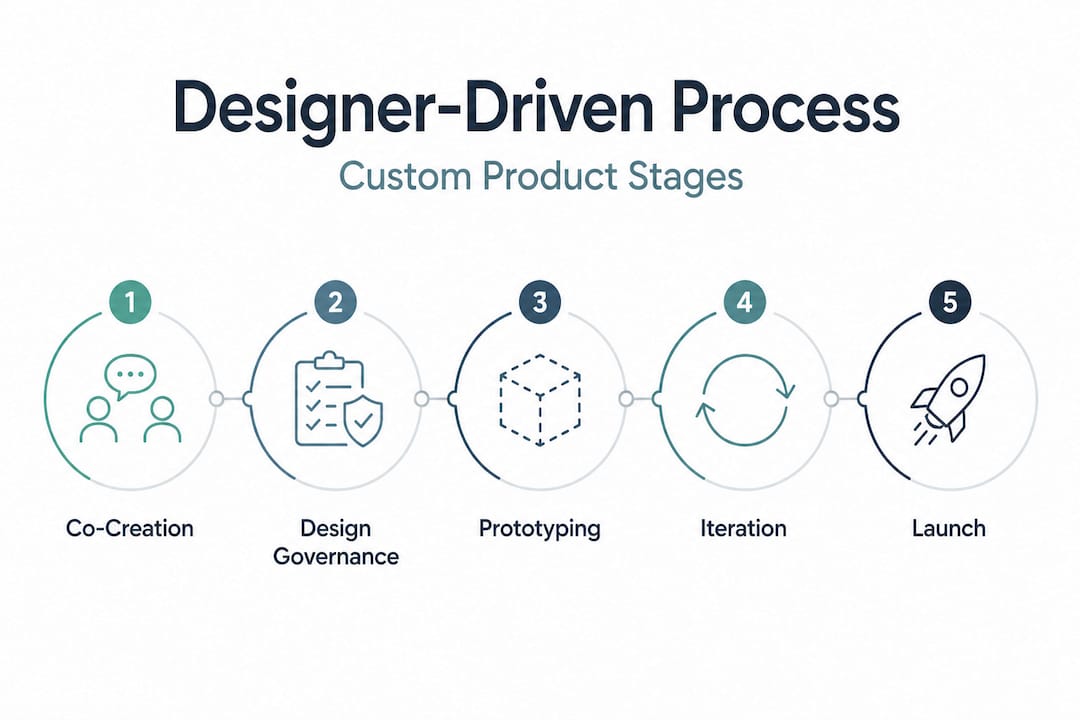
Designer-led prototyping loops are central to making custom products viable, using manufacturing-aware methods to catch feasibility and real-world issues before full production. The cost of catching a problem at the prototype stage is dramatically lower than catching it after a thousand units have been manufactured.
Here is what a strong prototyping cycle typically validates:
| Prototype stage | What is being tested | Why it matters |
|---|---|---|
| Digital render | Color accuracy, proportions, text legibility | Catches visual issues before any material is committed |
| Physical sample | Weight, finish quality, attachment mechanism | Reveals tactile and functional concerns |
| Wear test | How item performs on clothing, bags, or displays | Ensures the product works in its intended environment |
| Brand review | Alignment with visual identity guidelines | Confirms the finished product represents the brand faithfully |
Iteration, the process of reviewing and improving through multiple rounds, is built into effective prototyping. Each round surfaces new information that strengthens the final product.
For organizations producing event merchandise, conference giveaways, or advocacy accessories, following a structured custom pin prototyping guide helps teams understand exactly what to review at each stage and how to give feedback that moves the project forward efficiently.
Pro Tip: Request a physical prototype before approving any large order. Seeing and touching the actual item reveals details that no screen render can capture, from the weight of the pin to the exact sheen of the enamel finish.
What most people miss: Designers as uncertainty managers and innovation drivers
Alongside technical and creative prowess, designers quietly drive organizational confidence and sustainable innovation, an aspect many organizations overlook entirely.
Most organizations think of uncertainty as something to be resolved before design begins. They want to come to a designer with a complete brief and a clear vision. In reality, the best custom merchandise projects embrace uncertainty as a productive force, and skilled designers are the people who guide you through it safely.
Designers in customization systems define governance, manage uncertainty through guidance and reassurance, and drive data-driven iteration using qualitative discovery before mockups and quantitative validation afterward. This changes what “design” means at an operational level.
What this looks like in practice for your organization:
- Structured discovery before decisions: Designers gather qualitative input from stakeholders before presenting any visual concepts, ensuring mockups reflect real organizational needs rather than assumptions
- Guidance through ambiguity: When you are uncertain whether to produce pins, magnets, or keychains, a skilled designer helps you evaluate which format serves your audience and budget best
- Validation after concepts: Once initial directions are developed, designers use feedback mechanisms and review processes to confirm that concepts are working before committing to production
- Innovation through constraint: Paradoxically, the limits designers establish create space for genuinely original solutions rather than generic ones
Understanding how reviews shape custom merchandise choices is part of this data-driven approach. Real feedback from real recipients informs future design decisions, creating a cycle of continuous improvement. For specialized sectors, such as cultural institutions, the personalized museum accessories guide shows how this iterative, uncertainty-managed approach produces accessories that connect deeply with specific audiences.
“The designer’s most important job is not to eliminate uncertainty but to give your organization the tools and confidence to make good decisions inside it.”
This is the innovation driver role. By managing uncertainty and orchestrating data-driven cycles, designers keep your branded merchandise relevant, resonant, and reliably ahead of what competitors are producing.
A designer’s perspective: Why the real value isn’t what you think
With all these insights in mind, consider this perspective on what businesses should truly value when hiring or partnering with custom product designers.
Here is an uncomfortable truth most organizations discover only after their first major custom merchandise project: the biggest return on your design investment is not the finished artwork. It is the decisions you did not have to make alone.
When organizations partner with skilled designers, they often focus on deliverables: the pin file, the final render, the approved color palette. These are real and important. But the strategic value, the thing that saves time, prevents costly mistakes, and builds brand equity, is the designer’s ability to take ambiguous organizational goals and translate them into concrete, actionable choices.
At PinPerfect, we have seen this pattern repeatedly. Organizations come to us knowing they want “something meaningful” for their event or team. They are not sure whether that means pins or magnets, bold or minimal, cultural iconography or abstract design. The design process we offer is not just about producing artwork. It is about helping organizations discover what they actually want and then delivering it with confidence.
The businesses that get the most from their custom merchandise investment are the ones who bring designers in early, share their uncertainties openly, and trust the expertise that turns those uncertainties into clear decisions. They are not looking for someone to execute a predetermined vision. They are looking for a strategic partner who can see possibilities they cannot yet see.
Understanding the full meaning of meaningful accessories and brand identity is the foundation of this partnership. When you invest in a designer’s strategic capability rather than just their technical output, you transform what branded merchandise can do for your organization.
Bring your vision to life with expert custom design support
Ready to leverage experienced designers for your own project? Here’s how to get started.
At PinPerfect, our approach to custom merchandise combines everything explored in this article: genuine co-creation, smart design governance, rigorous prototyping, and expert uncertainty management. We work with businesses, nonprofits, cultural institutions, and advocacy organizations worldwide to transform brand stories into wearable, collectible, and meaningful accessories. Whether you are launching a corporate campaign, celebrating a cultural milestone, or equipping your team with branded merchandise that truly represents your values, our in-house designers are ready to guide every step.
Explore your options and start the conversation today at the PinPerfect store. When you are ready to build something specific, our team is waiting to help you customize your merchandise with the expertise and cultural sensitivity your brand deserves. Orders over 300 NIS ship free within Israel, and we deliver quality worldwide.
Frequently asked questions
What is the main responsibility of designers in custom products?
Designers facilitate co-creation, balancing brand identity and customer guidance to deliver feasible and effective custom products. As research confirms, they shift from generating artifacts to orchestrating the entire configuration experience for clients.
How do designers manage complexity in custom merchandise?
Designers use tools like modular architectures and configuration systems to limit choices to what is practical, balancing creativity with manufacturing needs. Constraining the solution space ensures cost, delivery, and quality tradeoffs remain manageable throughout production.
Why is prototyping important in custom product design?
Prototyping helps catch real-world issues and ensures designs are practical and brand-aligned before full production. Designer-led prototyping loops are central to making any custom product viable at scale.
Do designers only focus on the look of custom products?
No, designers manage uncertainty, set implementation boundaries, and drive innovation beyond just aesthetics. In customization systems, they also define governance, manage uncertainty through guidance, and drive data-driven iteration that shapes the entire product outcome.
How can organizations get the most value from working with custom product designers?
Engage designers early, provide clear goals and honest feedback, and trust their expertise to bridge your vision with practical production solutions. The most successful custom merchandise projects treat designers as strategic partners from the first conversation, not just executors at the final stage.